The Fifth Armored Division’s record of achievement is unsurpassed by that of any other division. And the ratio of its casualties to such achievement is the lowest in the entire United States Army.
It was the Fifth Armored which devised the married formation of tanks and infantry; it led the Normandy break through; it sprang the Falaise trap which meant the death of the Seventh German Army and the Field Marshal who commanded it. The Fifth Armored was the first division to reach the Eure River, the Seine, and the Our; it cut off near Mons thousands of Germans, later taken by the 1st Infantry Division. In one incredible day, it crossed the stubborn battlefields of World War I and outraced fleeing Germans from Nyon to the Belgian frontier. Throughout that day the route of its advance was a roll call of past battles:
Cambrai, Le Cateau, St. Quentin, Vimy Ridge, Valenciennes.
The Victory Division was the first to enter Germany. It breached the Siegfried Line early in September, while other parts of our armies were still demonstrating before it, or skirmishing within it. The Fifth Armored cleared the Hurtgen Forest, after the job had been begun by five infantry divisions. In four days, it overran its given area of the Rhineland. Three weeks later, within a few hours after crossing the Rhine, its engineers were maintaining bridges at Hamelin.
A few days later the division was on the Elbe, with bridge sites chosen and reconnaissance parties in boats–nearer to Berlin than any combat group in the American Army. While the Fifth Armored was accomplishing these feats, the American public heard little about the division because of the tight censorship under which it operated and because it did not possess an elaborate public relations staff. This history is now published to cast some light on these outstanding achievements. It tells how they were accomplished. It is also published as a tribute to the division’s Commanding General, Major-General Lunsford E. Oliver. The record of the division, we all agree, merely reflects his wise, patient, intelligent and always aggressive leadership. It is only borrowing a phrase from the greatest of Books to say that General Oliver created the division in his own image.
We hope you like the book.
Martin Philipsborn, Jr,
Page 1
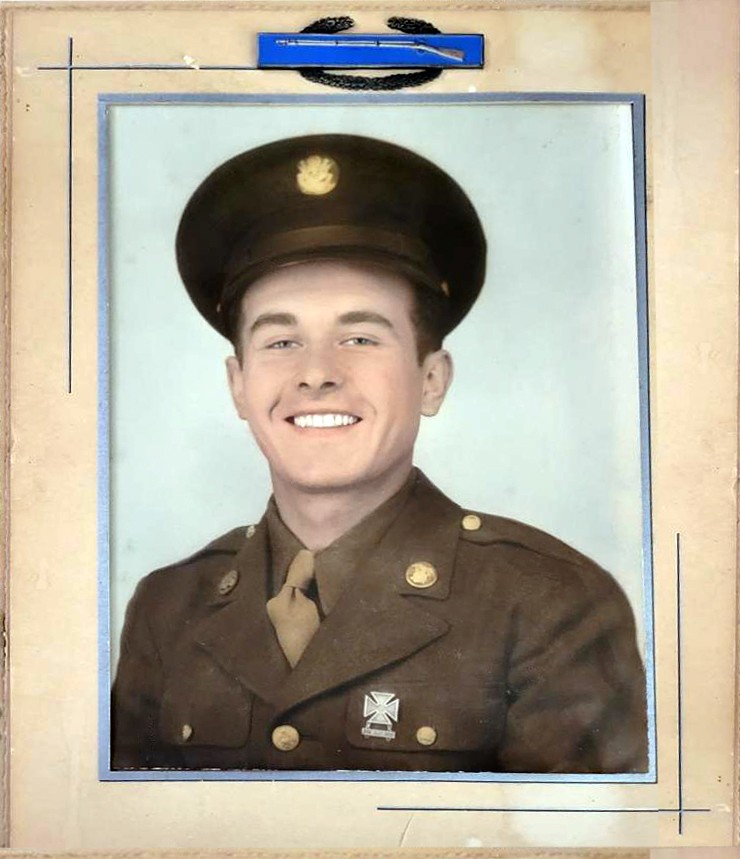
My father, John Joseph Tolejko was one of over 16 million men and women to serve in the U.S. Armed forces during World War 2. Of these 6.5 million served in Europe while 4.5 million served in the Pacific.
He began his military career by enlisting in the Army, October 21, 1942. He was 20 years old. He was Honorably discharged October 14th, 1945 just one week shy of 3 years.
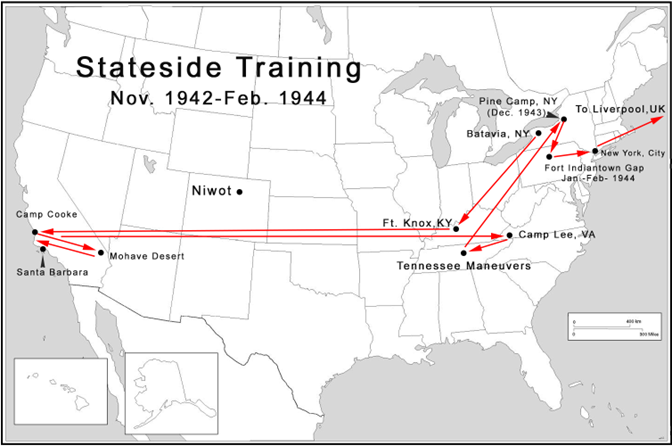
He trained in several locations around the country beginning in late 1942 through February 1944 when he shipped out to Liverpool, England, and the invasion of Europe (Operation Overlord).
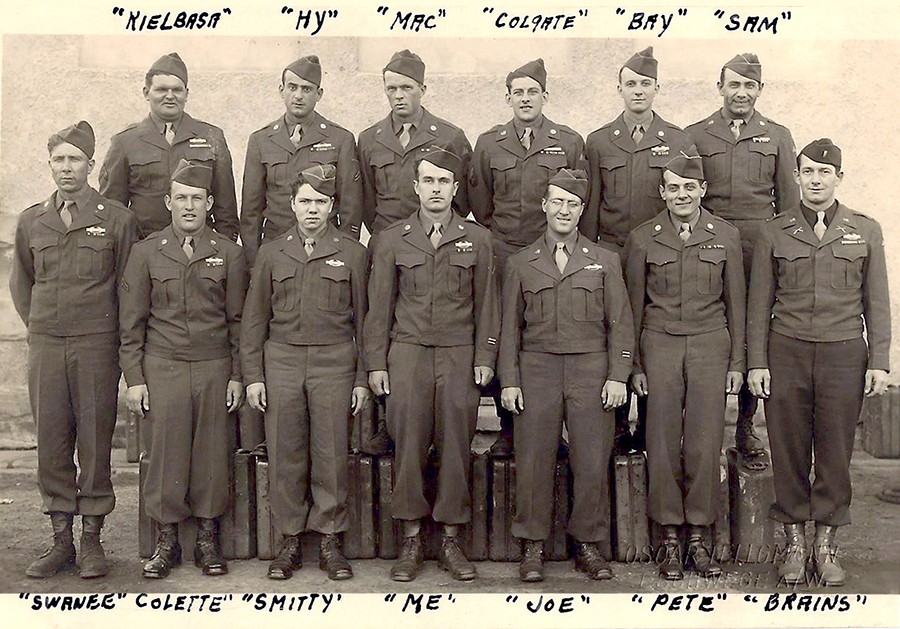
John was assigned to Combat Command Reserve (CCR) of the 47th Armored Infantry Battalion (AIB) a part of the 5th Armored Division. The 5th Armored was attached to Omar Bradley’s 1st Army while in England but soon after landing in France in July, 1944 they became part of George Patton’s 3rd Army where they remained for the duration of the war.
He became a truck driver tasked with responsibilities I had not thought about until I began my investigation into that part of my father’s life. My memories of his stories have faded but there exists enough literature to piece things together. There is a description of the role played by truck drivers at the end of this notebook.
USA Training Camps:
Fort Knox, Kentucky (Basic Training)- Late 1942-Spring 1943
Camp Cooke, California (Advanced Unit Training) Jan.-May 1943
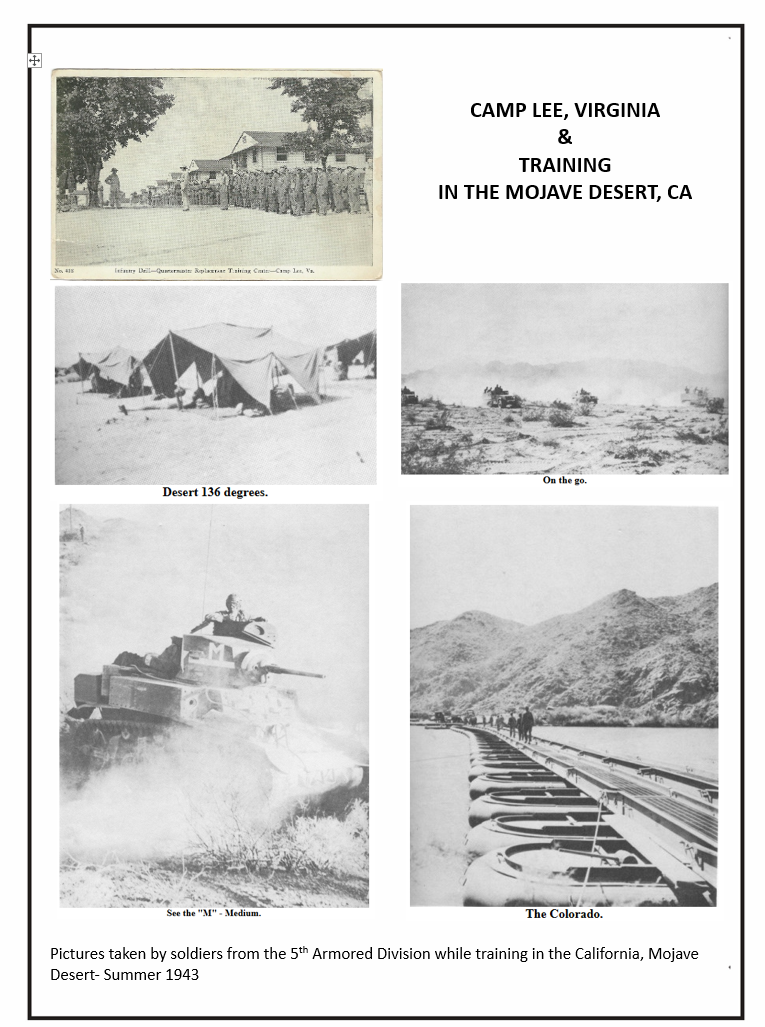
Mojave Desert- Eastern California for Intensive Field Training
Camp Lee, Virginia / Tennessee Maneuvers/Indiantown Gap, Pennsylvania/Pine Camp, NY (Final Preparation and Staging) June- Sept. 1943
My father’s designated rank was: Private in Company I, 8th Quartermaster Truck Training Regiment, 772. Quartermaster units were responsible for logistics: transportation, supply, fuel, food, and general material support.
Page 2
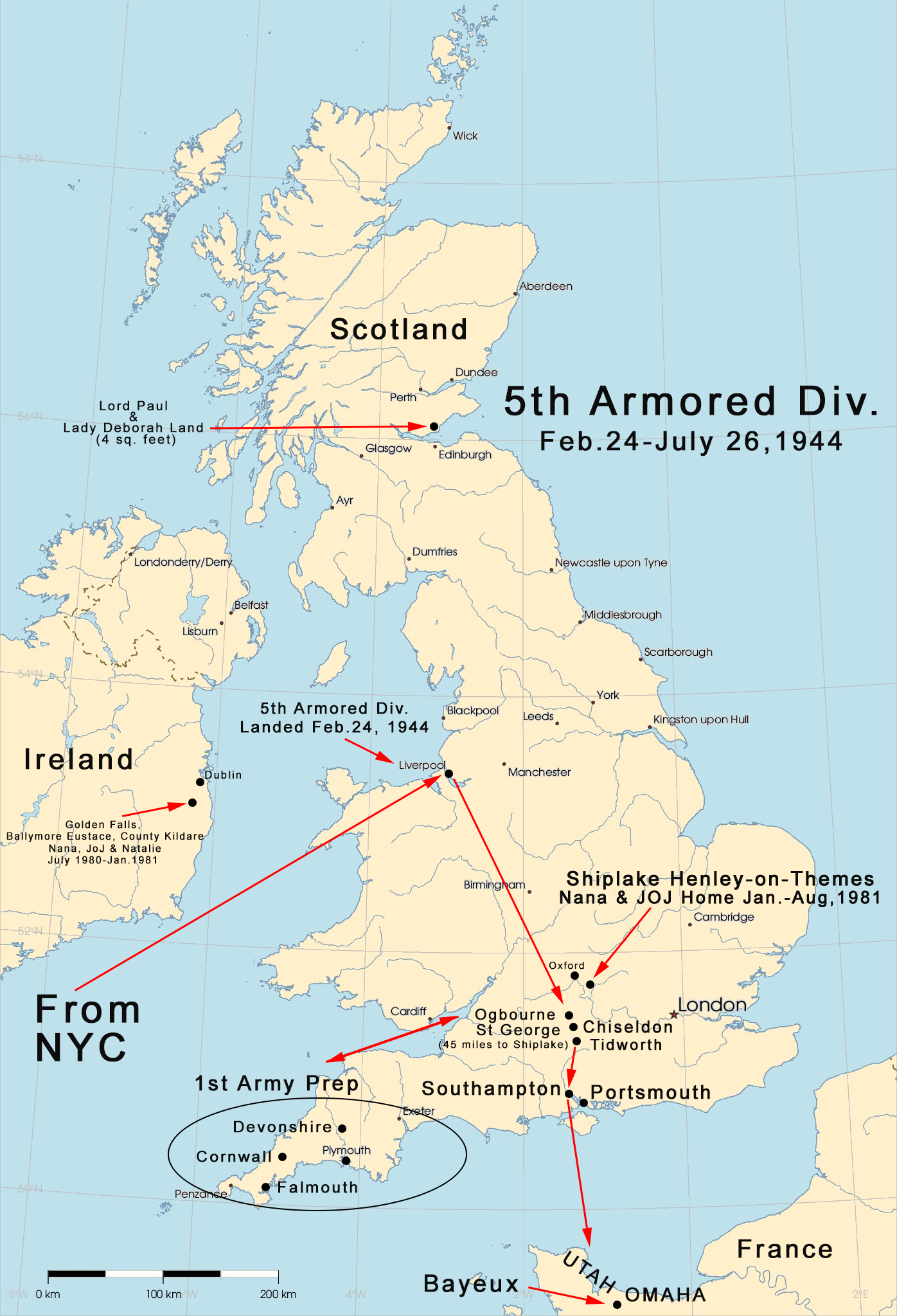
Departure for England: February 10, 1944 on 2 ships.
Page 3
February 1944-July 1944
Great Britain had been at war almost four and a half years when the 5TH Armored arrived there on 24 February 1944.
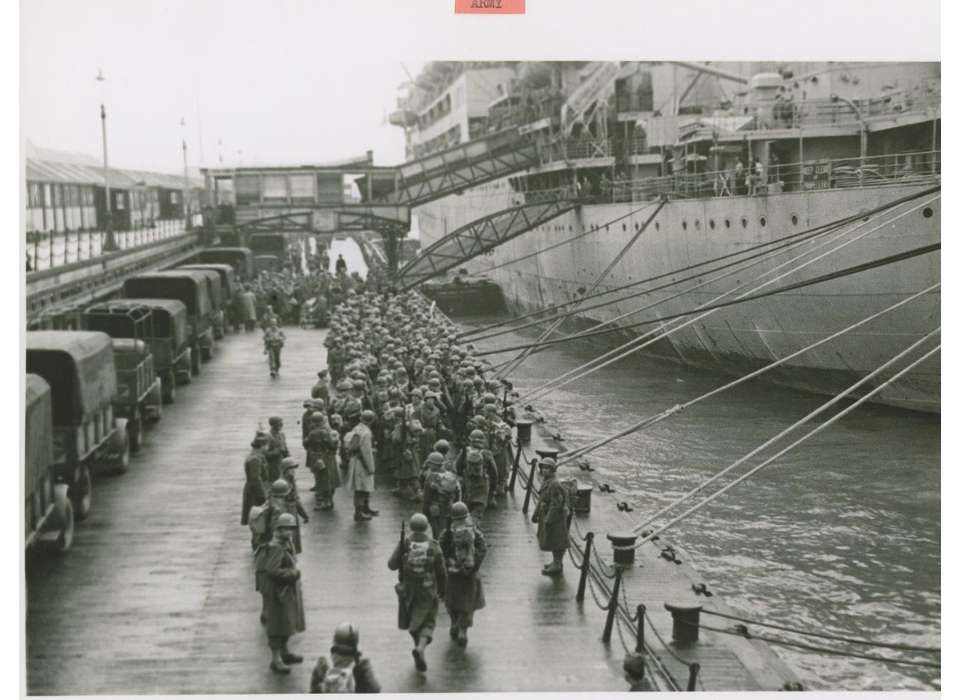 Upon landing in Liverpool, the 5th Armored Division immediately went into training at these camps: Chiseldon, Ogbourne-St.George and Tidworth-Perham Downes, all in Wiltshire.
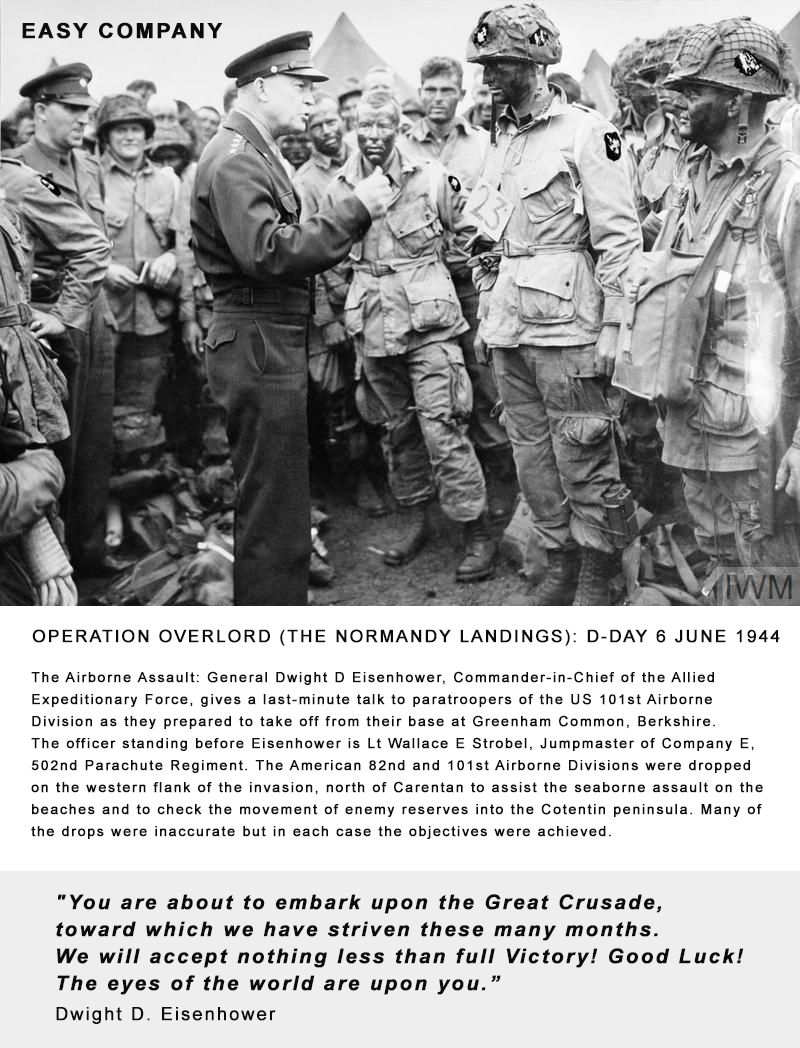
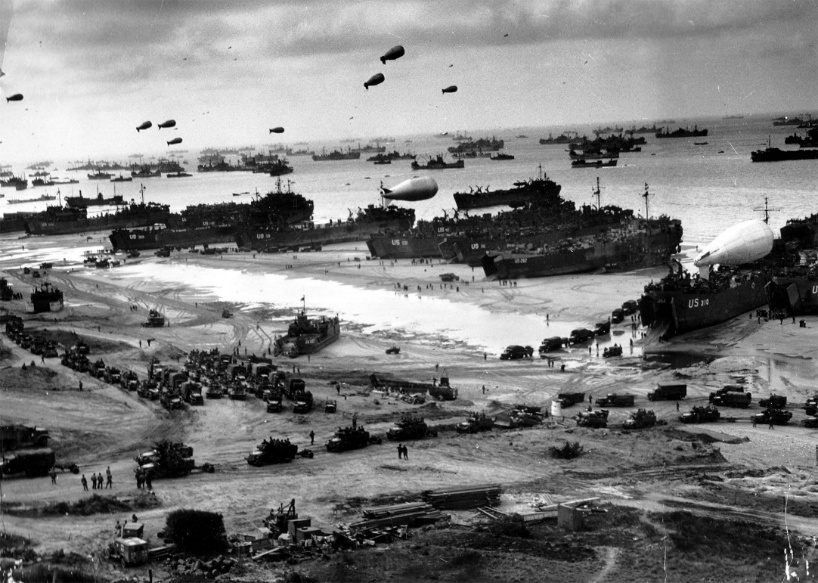
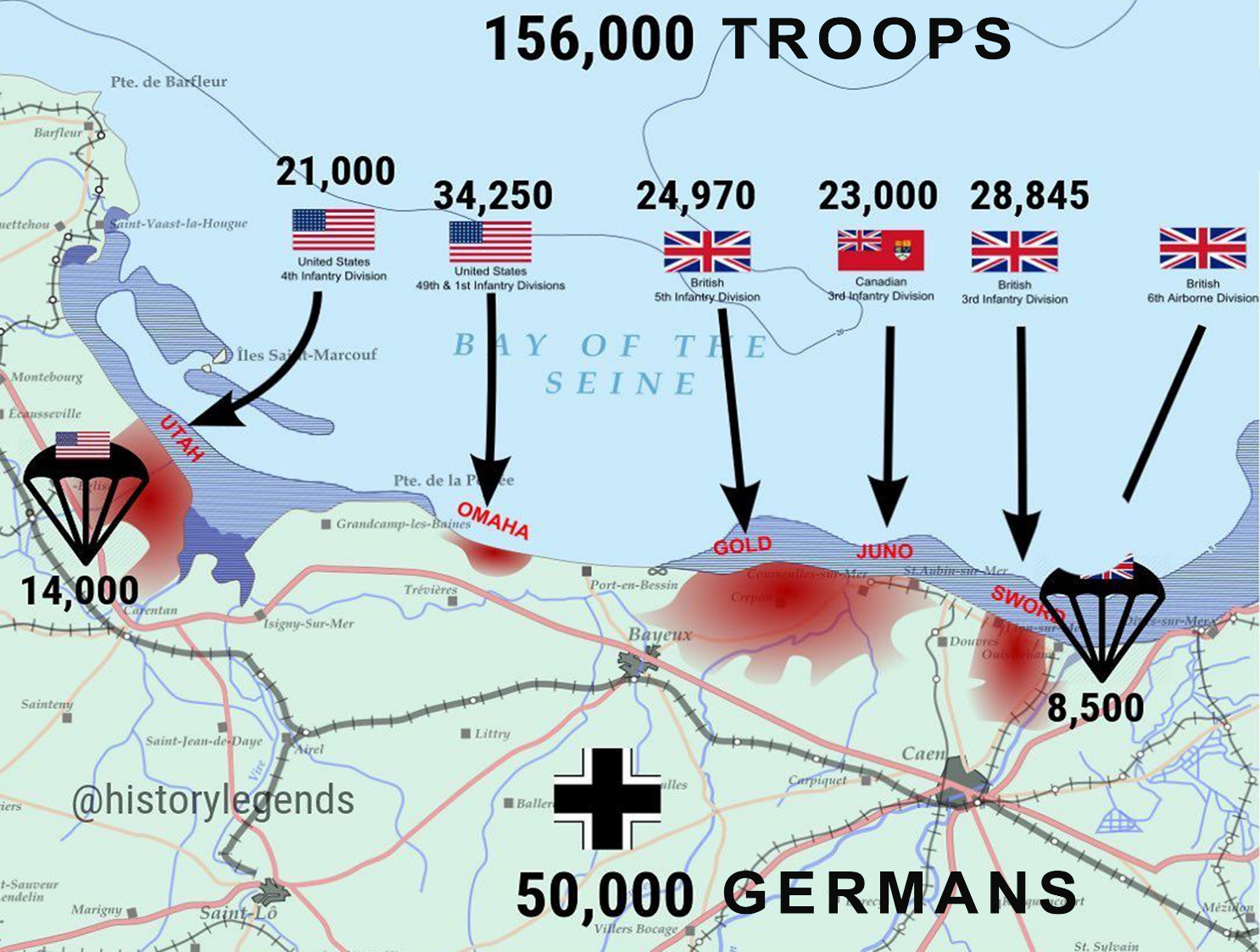
In April, 1944 the 5th Armored were called on to operate hundreds of camps and hotels in Cornwall and Devonshire. There they serviced and prepared the 1st Army troops (Led by Gen. Omar Bradley) as they prepared for the invasion of France- D-Day. Units under the 1st Army included the 82nd and 101st Airborne Divisions. The 5th Armored Division was held in strategic reserve in England, tasked with entering France after the initial invasion. Their presence helped the First Army plan for sustainment and expansion of the beachhead, knowing they had a fresh armored division ready to deploy quickly once the front stabilized.
A WEDDING
During the Fifth Armored’s final days in Britain, General Oliver called together his unit commanders. He had one last task he wished to perform before he took his division into battle. He wanted to join his tankers and infantrymen together in combat teams, which he dubbed “married companies.” This union, in its ultimate effect on the enemy, would later prove to be as devastating as the joining of fire and brimstone.
He told his commanders that within each combat command he wanted each individual infantry company to be “married” to a tank company. And within each married tank-infantry company he wanted each infantry platoon “married” to a tank platoon. According to his orders, the tankers and infantrymen in each of these married platoons were to eat and live together during their remaining days in England; this was to enable them to get to know each other well, because in battle they would fight together. each of its armored columns consisted of a line of tanks Interspersed with infantry filled halftracks. It was this close tank-infantry cooperation which later enabled the Victory Division to move with such swiftness through German defenses during its drive across France.
Page 6
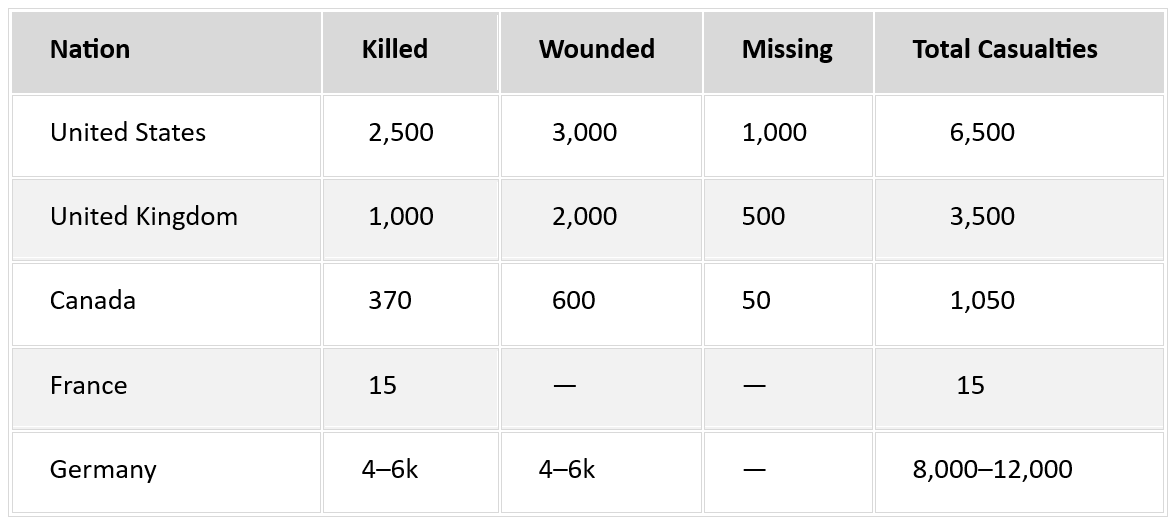
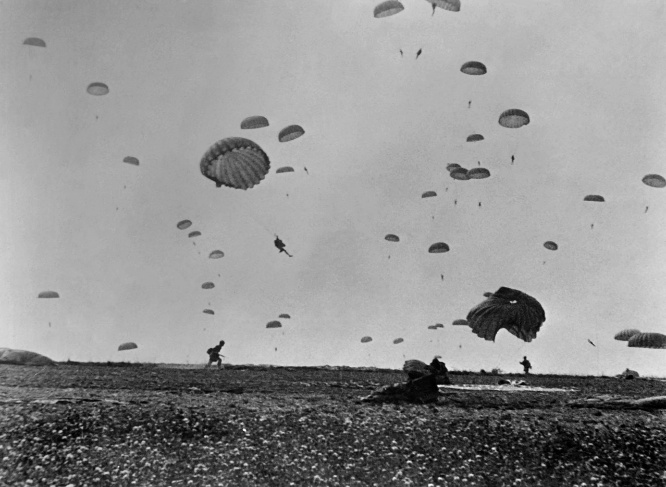
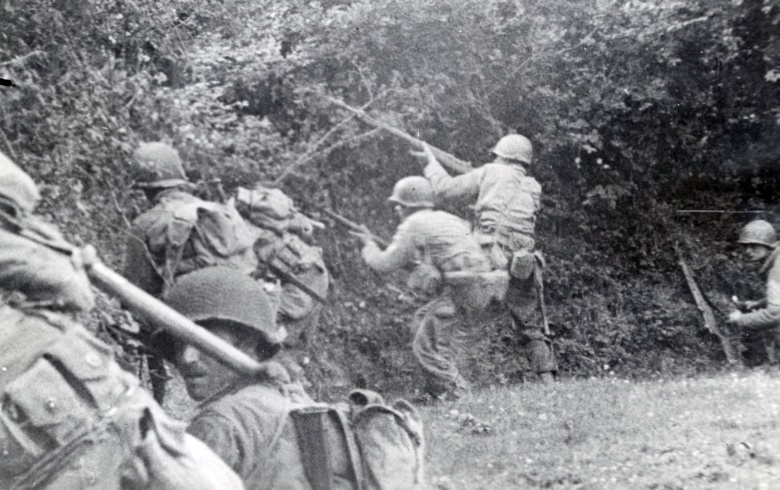
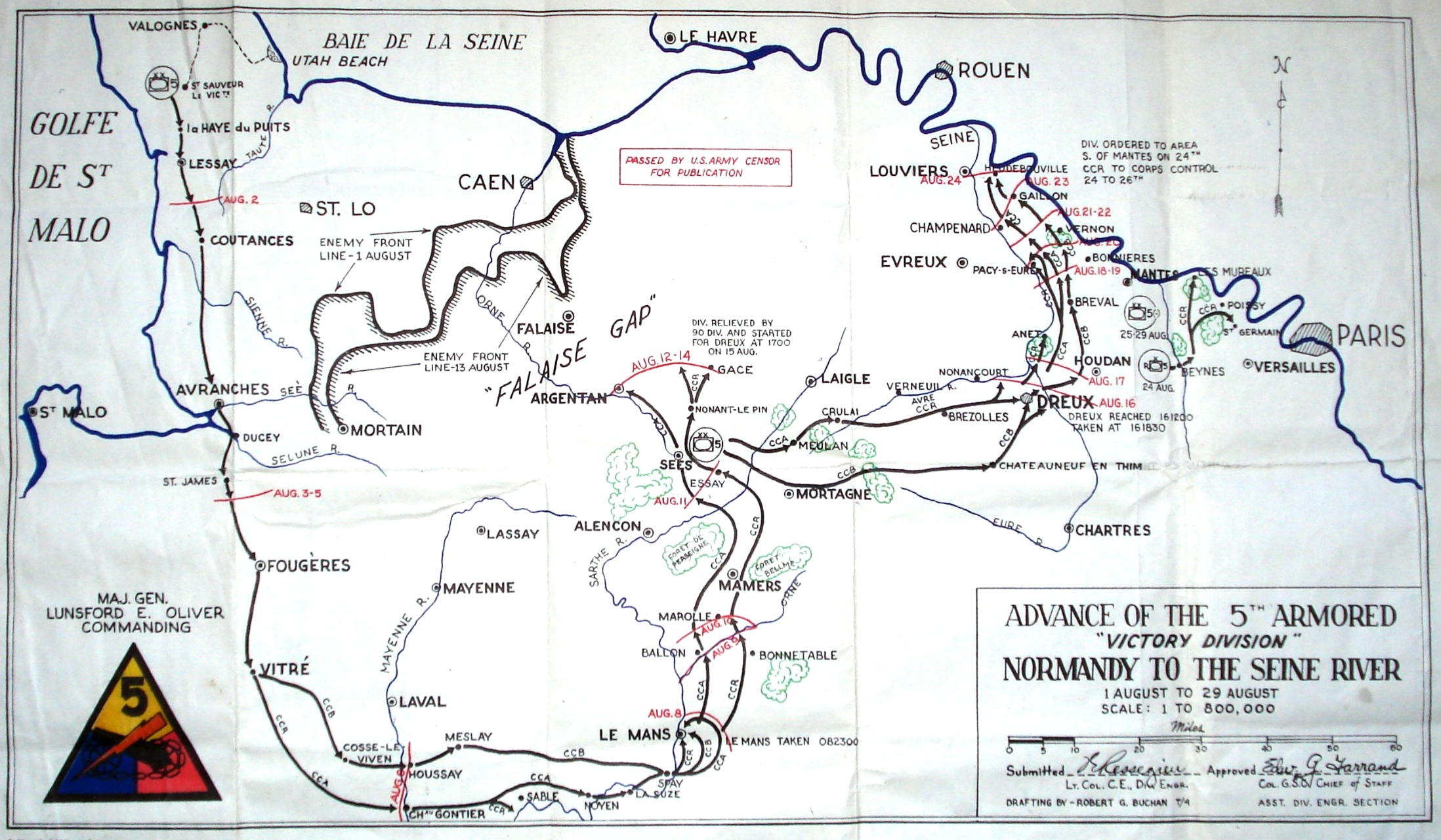
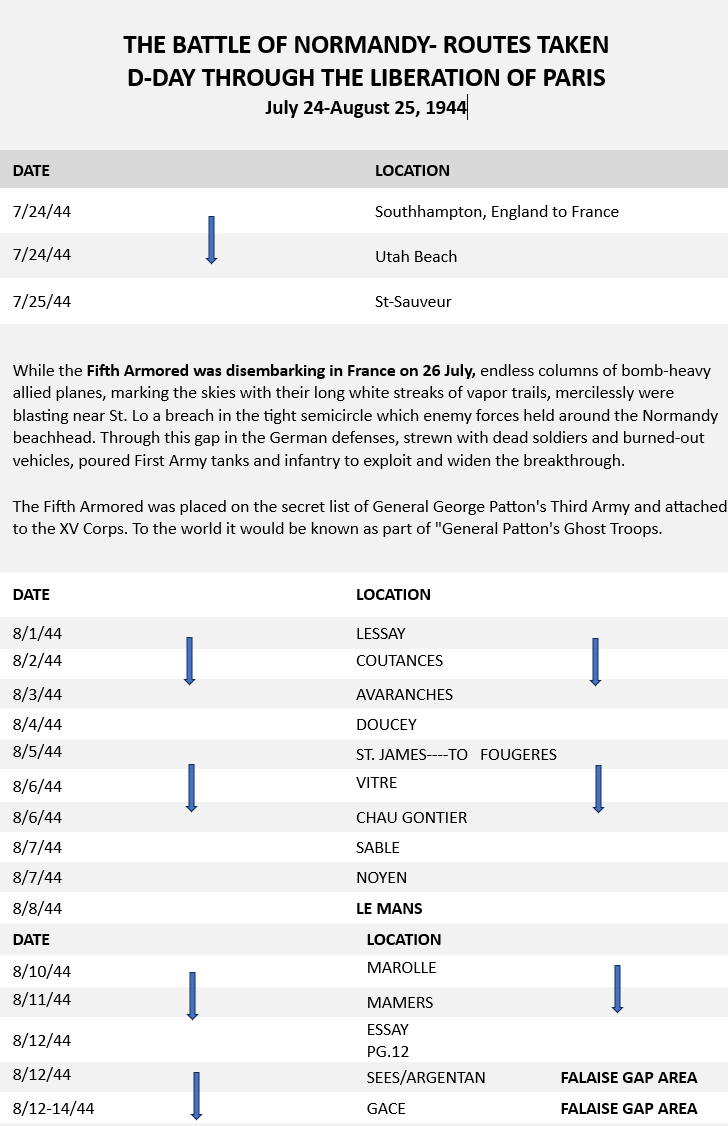
The Falaise Gap refers to a crucial point during the Battle of Normandy in World War II where Allied forces trapped a significant portion of the German Army Group B. This encirclement, known as the Falaise Pocket, saw the Allied forces closing in from the north and south, trapping the German troops within a narrow area. A key point where American forces were supposed to cut off the German retreat, but a controversy regarding a “halt order” from General Bradley to General Patton allowed a significant number of German troops to escape.
By the evening of 21 August, the pocket had been sealed, with an estimated 50,000 Germans trapped inside. Approximately 20–50,000 German troops managed to escape the pocket before it was closed. The battle resulted in the capture of tens of thousands of German soldiers, a significant number of casualties on both sides, and the eventual liberation of Paris.
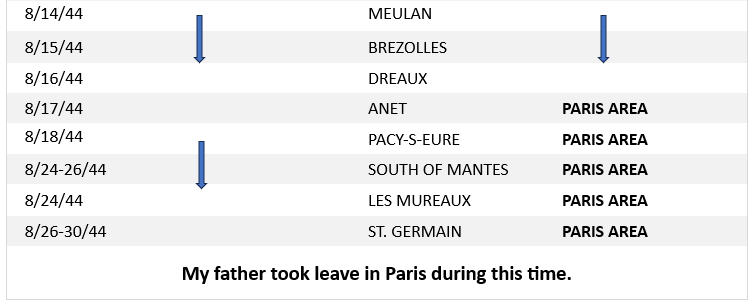
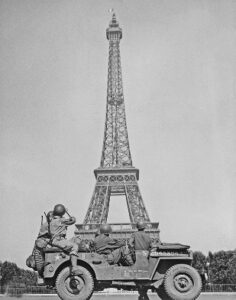 PARIS LIBERATED– It began on August 19, 1944, with a French Resistance uprising and culminated in the German garrison’s surrender on August 25, 1944. This event marked the end of four years of Nazi occupation.
August 1944, the Battle of Normandy ended. The allied armies crushed under a shower of steel
100, 000 Germans in the Falaise-Chambois pocket. Located on the very spot of the battle between Argentan and Vimoutiers, the Memorial offers an exceptional view over the valley of la Dives.