
My Father & The 5th Armored Division

Part 2: Normandy To Paris-Then On To The Sigfried Line (Germany)

D-DAY THROUGH JULY 24, 1945- ARRIVAL OF THE 5TH ARMORED DIVISION & MY FATHER

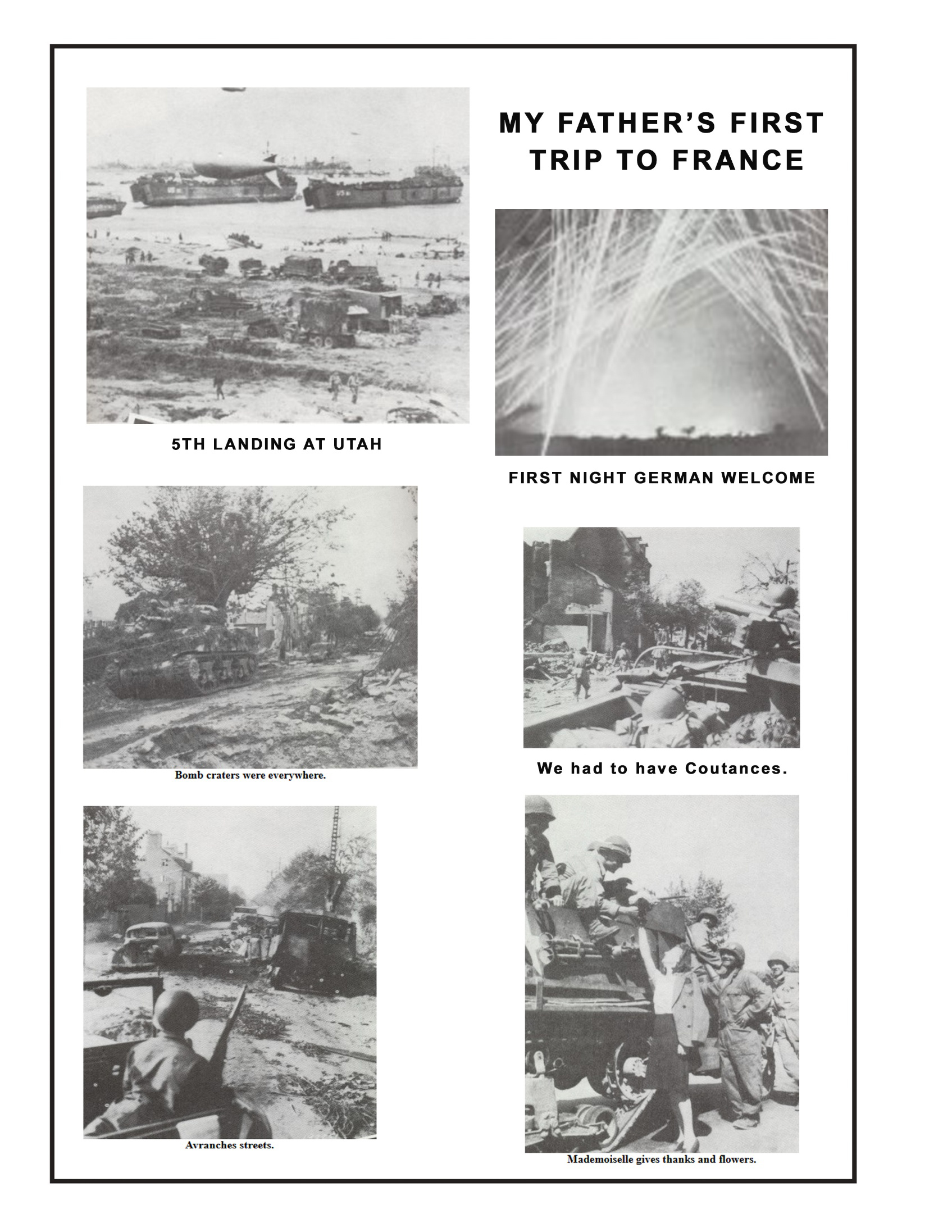
So, what took place in Normandy, France between D-day and the day my father and CCR Company waded ashore at UTAH Beach? A lot.

An estimated 156,000 Allied troops took part in D-Day, June 6, 1944. Six weeks later when the 5th Armored landed, Allied forces swelled to over 1.25 million soldiers. Here is a breakdown by nation:

Estimated Allied Troop Strength in France by Nation – July 24, 1944

Nation

Estimated Troops in France

United States

   840,000

United Kingdom

   300,000

Canada

   100,000

Free France

    5,000–10,000

Poland

    3,000–4,000

Other Allies*

    5,000–10,000

Total

    1.25 million

*Other Allies include Belgium, Netherlands, Norway, Czechoslovakia, and some small support detachments from other nations.

Allied Forces in France- after D-Day

Between D-Day on June 6, 1944, and the arrival of the U.S. 5th Armored Division on July 24, 1944, the Allied forces were engaged in intense and grueling combat to expand their foothold in Normandy. The initial landings had secured the beaches, but the subsequent push inland was met with fierce German resistance, challenging terrain, and logistical hurdles.

June 6 – Late June: Establishing the Beachhead

Following the successful landings on D-Day, Allied forces aimed to secure key objectives to facilitate further operations. The U.S. forces focused on capturing the port city of Cherbourg, which was vital for logistics and supply lines. After intense fighting, Cherbourg fell on June 27, although the Germans had heavily sabotaged its port facilities before surrendering.

Simultaneously, British, and Canadian forces were engaged in protracted battles to capture Caen, a strategic city in the eastern sector. Despite several offensives, including Operations Perch and Epsom, progress was slow due to determined German defense and the challenging terrain.

Page 14

July: Stalemate and Attrition- Hedgerow Fighting

Throughout July, the Allies faced a stalemate characterized by attritional warfare. The dense hedgerows of Normandy’s countryside provided the German defenders with natural fortifications, making advances costly and slow. Operations such as Charnwood and Goodwood were launched to break the deadlock, with limited success.

In the American sector, the capture of Saint-Lô on July 18 was a significant milestone. This victory set the stage for Operation Cobra, a major offensive aimed at breaking through German lines and facilitating a rapid advance into Brittany and beyond.

July 24: Arrival of the 5th Armored Division

The U.S. 5th Armored Division landed at Utah Beach on July 24, 1944, joining the fray just as Operation Cobra was commencing. Their arrival marked a turning point, as the Allies began to achieve significant breakthroughs. The 5th Armored Division, known for its speed and maneuverability, played a crucial role in exploiting the breaches in German lines, contributing to the rapid liberation of large swaths of France in the ensuing weeks.

In summary, the period between D-Day and the arrival of the 5th Armored Division was marked by intense combat, strategic offensives, and gradual progress against formidable German defenses. The groundwork laid during these weeks was instrumental in the subsequent successes of the Allied forces in Western Europe.

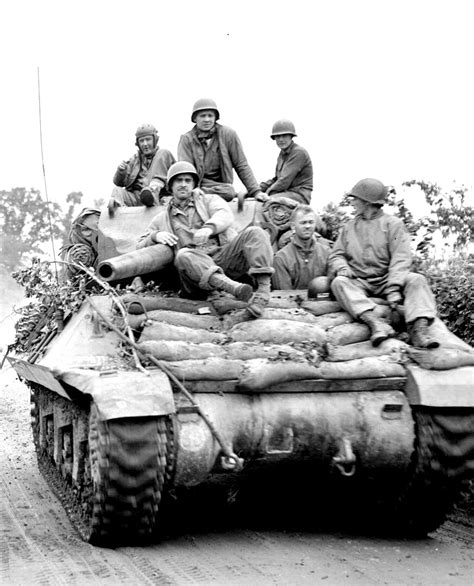
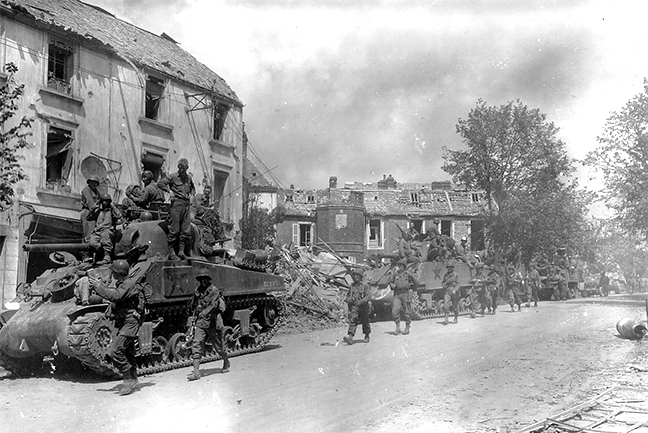
Men on Tank
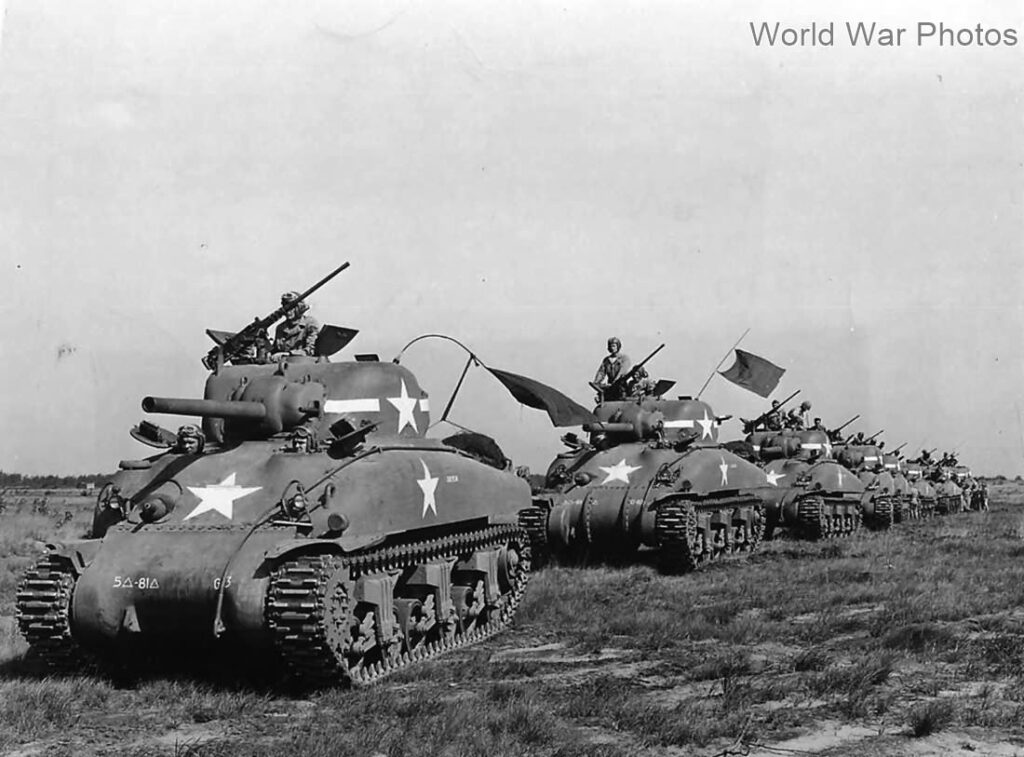
Tanks

Allied Adaptation:

  • U.S. troops improvised by welding metal “teeth” onto tanks—called “Rhino tanks”—to break through the hedgerows.
  • Infantry developed tactics involving combined arms, where tanks, infantry, engineers, and artillery worked together closely to clear each field.                                                                         

Page 15

The hedgerow fighting lasted from mid-June through most of July 1944, especially before… Operation Cobra, when the Allies finally broke out of Normandy into open country. It was grueling, deadly work, often described by veterans as some of the toughest combat they faced in the war.

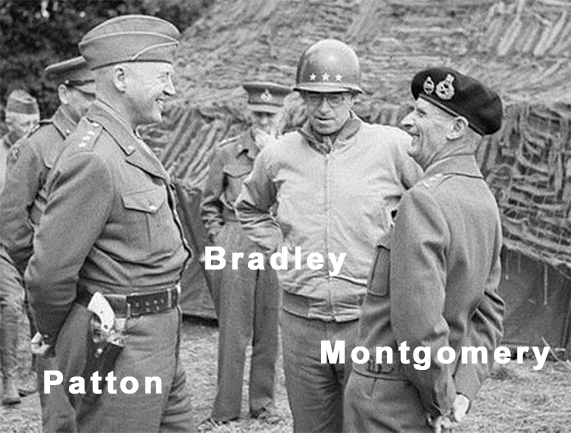
Operation Cobra was an offensive launched by the First United States Army under Lieutenant General Omar Bradley seven weeks after the D-Day landings, during the Normandy campaign of World War II. The intention was to take advantage of the distraction of the Germans by the British and Canadian attacks around Caen in Operation Goodwood,[12] and thereby break through the German defenses that were penning in their forces, while the Germans were unbalanced. Once a corridor had been created, the First Army would then be able to advance into Brittany, rolling up the German flanks once free of the constraints of the bocage country. After a slow start, the offensive gathered momentum and German resistance collapsed as scattered remnants of broken units fought to escape to the Seine. Lacking the resources to cope with the situation, the German response was ineffectual mainly due to the effect of Operation Bluecoat and the entire Normandy front soon collapsed. Operation Cobra, together with concurrent offensives by the British Second Army and the Canadian First Army, was decisive in securing an Allied victory in the Normandy campaign.

tank and soldiers

Page 16

Page 17

Page 18

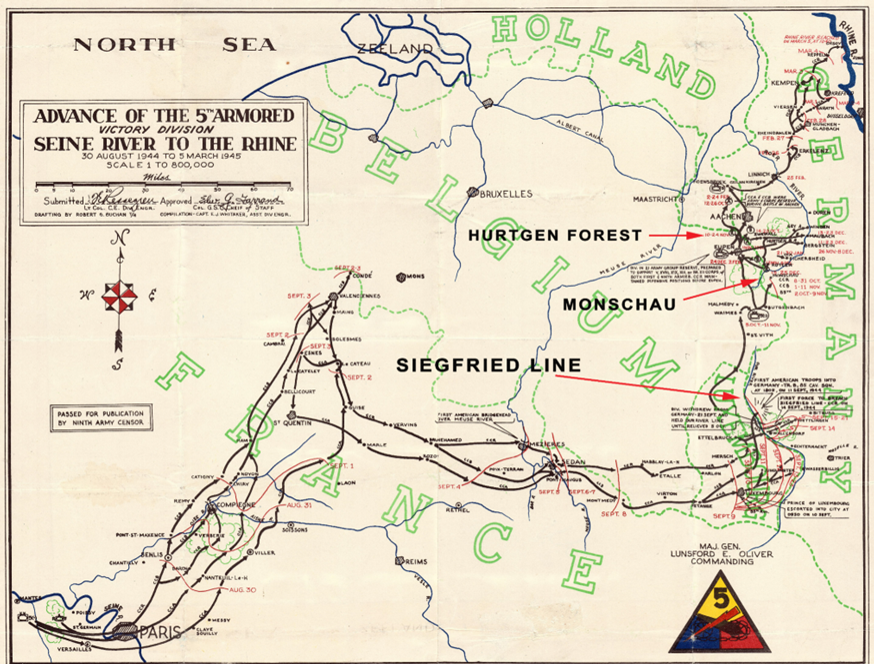
PARIS TO SEIGFRIED LINE

Paris glowed with exaltation in its newly won freedom and as the remnants of the broken German armies fled through Northern France and Belgium toward their homeland, GIs and generals alike seemed convinced that the war could not last much longer. Except among the Fifth Armored Division Intelligence officers.

Some of the U. S. divisions were reassigned to different armies and corps. The Fifth Armored was transferred from General Patton’s Third Army to General Courtney H. Hodge’s First Army (26 August). It was also placed in General Leonard T. Gerow’s Fifth Corps (29 August). Its team mates in this corps were the 4th and 28th Infantry Divisions. The First Army’s other two corps consisted of (VII Corps) 3rd Armored, 1st and 9th Infantry Divisions; (XIX Corps) 2nd Armored, 79th and 30th Infantry Divisions.

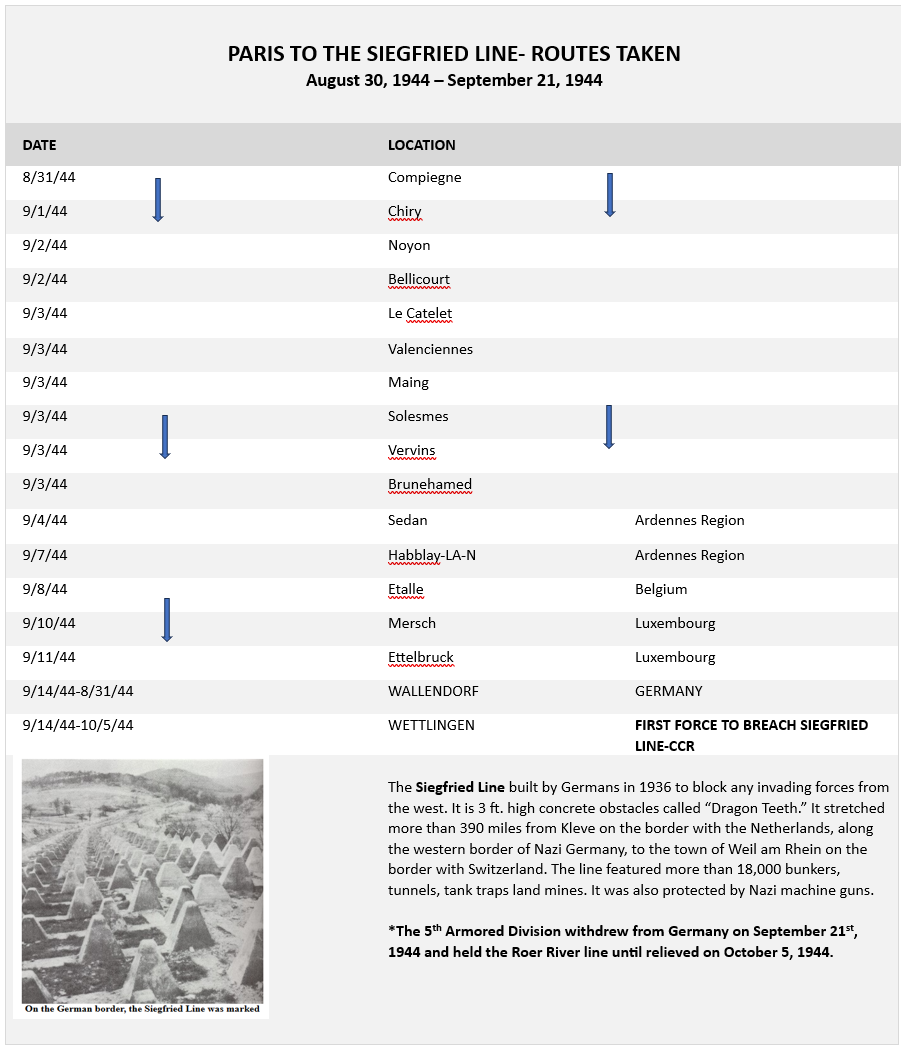
Summary of Events 8/31/44- 9/19/44

  • In its race to nip at the heels of the fleeing German forces, CC R overran seven enemy artillery pieces south of Bethisy. Next, its two task forces had plunged into the historic Compiegne Forest at Orrouy and Gilcourt. By 8 in the evening, they were running into heavy resistance.
  • CC R reached Choissy on the river at 2 in the afternoon, it found another destroyed bridge. CC R, therefore, had been ordered to cross over the new treadway bridge (floating bridge built by CC R) at Compiegne.
  • While the Fifth Armored was deftly knifing its way north to Conde, on its left a vast German force was also moving toward Belgium, but more slowly. Consisting of about 50,000 soldiers, it was hastening to get back to Germany. The immediate objective on its escape route was Mons in Belgium. But the arrival of the Fifth Armored at Conde, which lay about 16 miles directly west of Mons, blocked this return path and thus sealed the doom of the German force.
  • On September 4th leaving from Le Cateau, CC R was off on a record-breaking dash. It shot through Guise, Hirson, Maubert, Fontaine and by 3:40 that afternoon its lead elements were in Charleville on the Meuse River. This was a motor march of 96 miles in eight hours and ten minutes.
  • The job of liberating historic Sedan, a contested city in other wars, fell to CC R’s Task Force Boyer. Pushing off early from Mezieres on 6 September, the task force started winding through the narrow, mountainous roads. It had to batter its way through several roadblocks and remove trees which the Germans had felled across the route with explosives. It also encountered in the streets of the village’s piles of old wagons and other junk behind which the German soldiers had set up their sputtering machine guns. Fuel was in short supply and this delayed our advancement toward Luxembourg for several days.
  • September 10, 1944- Behind the leading wave of tanks General Oliver escorted Prince Felix of Luxembourg, who had been in exile for four years, back to his capital. 

At Habay la Neuve Capt. Arthur Whitley’s A Co., 10th Tank Bn., tangled with a German force which tried unsuccessfully to halt CC R’s advance. In the exchange of shell fire one of the
Sherman tanks was penetrated by hits on three sides, but fortunately none of the crew was injured and the tank was not destroyed.

Page 19

In 41 days of combat the Fifth Armored had come a long way. It was more than 700 miles away from the hedgerows and apple orchards of Normandy. It had fought through three countries. And now it was ready to lead the Allied Armies onto the soil of the nation that had unleashed this war on the world.

But to strike this blow against Germany, the Fifth Armored would have to storm the famed Siegfried Line, the crescent of steel and concrete fortifications which supposedly made the Reich impregnable, The division, however, was not deterred by these looming pillboxes. Its confidence was still running high. It was eager to plunge across the border immediately, even though its supply lines were stretched trickle thin, its strength was spread over a wide area, and the bulk of its supporting infantry divisions were miles behind.
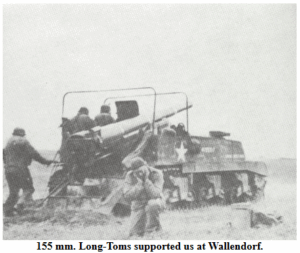
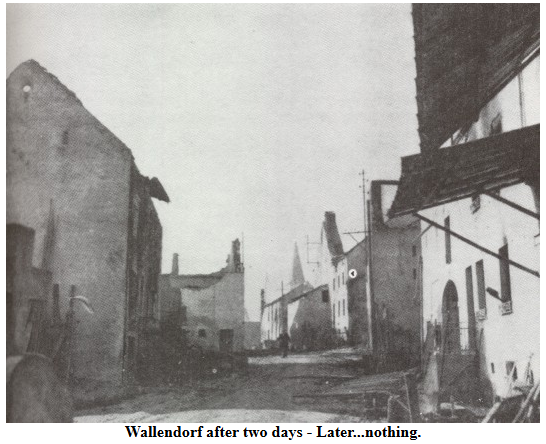
Artilery fireCC R pushed a few miles further east and assembled at Bruckenhof; its Task Force Boyer occupied Ermsdorf about four- and one-half miles southwest of the German bordertown of Wallendorf. Moving across CC R’s center zone, CC B took over the sector north of Diekirch; its headquarters was set up at Schindler, while Task Force Anderson assembled at Michelau and Task Force Gilson at Hoschied.
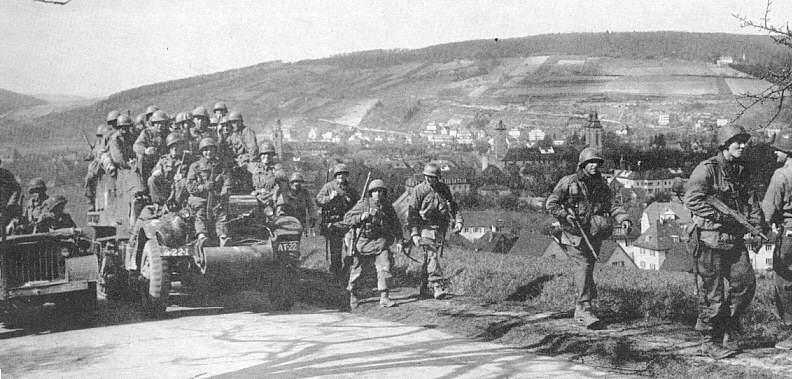
*September 11, 1944- The Fifth Armored is officially recognized by the U. S. Army as being the first of our ground forces to enter the Reich.

CC R was ordered to plunge into Germany and capture the high ground south of Mettendorf, which was about five- and one-half miles beyond the border.Its supplies were dangerously low; on 11 and 12 September First Army had to issue 125,000 captured rations. Furthermore, it was invading an area composed of ideal defense terrain; the land was a series of high ridges, deep narrow valleys and forests. This was the plan of attack which CC R’s staff worked out: The 47th Infantry Bn.’s three rifle companies would jump off from Luxembourg a little to the north of the German bordertown of Wallendorf; they would wade the Our River (which separated Luxembourg from Germany), scale the steep pillbox-dotted mountainside and seize the first high ridge on the opposite shore. Supporting these infantrymen would be direct fire from the 10th Tank Bn. A few hundred yards south of this operation the 112th Regiment’s 1st Bn. would also cross the Our River at Wallendorf.

Page 20

 After clearing the houses in Wallendorf it would then pass over the southern tip of the same high ridge which the 47th was attacking a little further north; next, it would cross the narrow valley on the other side of the ridge and attack the town of Biesdorf, which was on the next rise about 2,000 yards northeast of Wallendorf. Both battalions would have the support of the big guns of the 95th and 400th Artillery Battalions and also of the 155 mm. “Long Toms” of the 987th Field Artillery Bn. A bridge was to be built at Wallendorf by C Co., 22nd Engineer Bn., while A Co., of the 22nd would go along with the infantry to use flame throwers and pole charges (dynamite charges on the ends of poles) against the concrete blockhouses, The flanks would be protected by C Co., 628th Tank Destroyer Bn.

At 11 the next morning, 14 September, the first wave of the 47th Infantry Bn., began moving toward the river. They were met, however, by overpowering machine gun fire from the pillboxes on the opposite bank. Prevented from crossing here, they moved further downstream and forded the river at Wallendorf with the tanks of the 10th Tank Bn. As the column pulled up out of the stream and into the town it raked the buildings with all its guns in action. Some of the structures immediately caught fire. Many of the houses, however, were of concrete which deflected the shells, When the German soldiers continued to resist behind these solid protections, the engineers then put their searing flame throwers into use.

The 47th Infantry Bn’s three rifle companies followed the tanks up the steep route. At the summit   they spread out over the ridge and with the tanks’ help began subduing the individual pillboxes.          

Page 21

Thus, as CC R bedded down to spend its second night in Germany, it was completely through the Siegfried Line’s belt of scattered pillboxes and was sitting on the division’s objectives. And neither of its task forces faced any formidable concentrations of enemy troops. It did not, however, feel completely secure in these new positions. A slight anxiety had been aroused in the combat command by the report that the Germans had regained possession of the Gay Creek ford. This uneasiness was intensified later when it was learned that enemy patrols had worked their way back into Wallendorf about midnight.

When the infantrymen began climbing the southwest slopes of Hill 298 their ranks were swept on both flanks by enemy machine gun fire. C Co., 10th Tank Bn., and B Co.’s 2nd Platoon, 628th Tank Destroyer Bn., immediately retaliated; with direct smothering fire they blasted the German gun positions, which were located in stone houses. As daylight faded the infantrymen consolidated their positions on the embattled slopes. But at nine that evening a counterattack of enemy foot troops and tanks rolled down on them from the crest of the hill. The charging Panzers turned on their spotlights in order to direct their tank and machine gun fire against the individual positions of the GIs. This enemy onrush forced the infantry battalion to fall back to the eastern edge of Wettlingen where it prepared to launch another attack the next day.

The Germans were active at other points along the bridgehead’s northern flank that night. Enemy patrols and mortar fire harassed CC R and throughout the night the shrill scream of approaching artillery shells was heard in all sectors.

Day dawned on 19 September with a burst of violence for CC R’s Task Force Boyer on Hill 407. Shortly after the arrival of daylight on this foggy morning the hill was pounded with the heaviest concentration of artillery fire that the Germans had thus far laid down on this area. The barrages at first landed on the forward slope of the hill; then they were progressively shifted to the top of the elevation and finally down its reverse slop. All elements of the task force were blanketed with the exploding shells, including the supply trains. One shell ripped through CC R’s command post tent as Colonel Anderson and Lt. Col. Dickenson were having breakfast. 

Page 22

Other sectors along the edges of the Fifth Armored’s corridor through the Siegfried Line also had to withstand enemy attacks that morning. North of Niedersgegen an enemy force of tanks and infantrymen supported by artillery fire descended on Task Force Gilson. Shortly before noon it was reported that Wehrmacht infantrymen had infiltrated back into the houses in Wallendorf and were putting machine gun and rifle fire on the ROER River treadway bridge there. The increasing tempo of enemy activity as the Fifth Armored’s situation in the Siegfried Line grew steadily worse that day.

CC R was ordered to withdraw from Germany and assemble south of Diekirch in Luxembourg. As this move got under way, the division’s artillery batteries covered the enemy positions with heavy concentrations of fire to keep the Germans from disrupting the operation. Despite this intense shell fire, Panzer tanks and Wehrmacht infantry emerged from the woods east of Biesdorf and attacked the married B Companies of the 10th Tank Bn. and the 47th Infantry Bn, as they were passing through the town.

Thus ended the Fifth Armored’s first venture into Germany. Although the division had been forced to make its first retreat in this Battle of the Wallendorf Corridor, it had nevertheless served its purpose here. 

  1. First, well into Germany, it had drawn a horde of German troops, which prevented them from opposing the Allies’ main breaching of the Siegfried Line being made at Aachen.
  2. The Fifth Armored also severely mauled these enemy units which were thrown against it here. It killed more than 2,000 German soldiers and captured 1,218.
  3. 45 of 100 Panzer Tanks were destroyed, while fighter planes knocked out 19 more.


Censorship Is Lifted
Shortly after the Fifth Armored’s Wallendorf action the veil of censorship which had covered its identity was removed and the fact that it was fighting on the western Front was announced to the public. Press correspondents were permitted to file stories about its exploits on the continent.

New York Times, 1 October 1944

WITH THE FIRST ARMY IN GERMANY, September 30.- General Hedges took security wraps off another of his divisions today and disclosed for publication that the Fifth Armored Division (“Victory” Division) was one of his ace outfits which stormed across France after the American break through near St. Lo. This division entering combat for the first time in the drive across France was in forefront of the spectacular American operation and helped make a lot of tank history.

In the first twenty days of combat the Fifth Armored Division drove 400 miles to the Seine River and was one of the divisions which swept south from Countances and then hooked north from Le Mans to set the Falaise-Argentan trap which gave Von Kluge’s Seventh Army such a terrific mauling. Military men will be charting that armored campaign for years to come. The Fifth Armored Division started its operations from assembly area in Normandy’s hedge bordered fields in August 1. Tanks plunged through St. Lo gap and reared south to drive deep into enemy held territory.

Page 23

The division proudly boasted that this operation was the first time a full American Armored Division had been used in exploitation mission behind enemy lines.
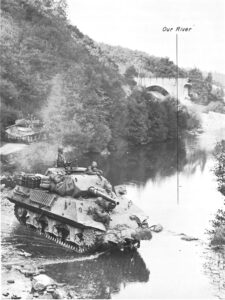
crossing riverTo accomplish mission the division thrust 150 miles south, then continued 100 miles to Le Mans, then turned and drove 50 miles north to Argentan. Tanks of the Fifth Armored Divisionwere first into both Le Mans and Argentan and were the first armor astride the main highway to Paris. Between Argentan and Gace the Fifth Armored had one of the toughest battles of the drive. They fought Germans for three days as pincers of trap closing in on the Seventh Army struggling to escape to the east. Then the armor wheeled and pushed on to the Seine. In this drive the division lists, 2,800 Germans killed and 4,300 prisoners of war, with its own casualties extremely light.

Across the Seine, the Victory Division kept wheeling to the east, and fought its way into Luxembourg, and when tanks rolled into the city, the Prince of Luxembourg rode with the Division Commander, Major General Lunsford E. Oliver. Luxembourgers gave the Tank men a rousing welcome along with the Armored Infantry, and quickly recognized the Prince of the Grand Duchy. They stormed his jeep and carried him on their shoulders through the streets.

End NYT Article

NEXT- THE HURTGEN FOREST, MONSCHAU AREA & FOY

Page 24

Sign Up for Blog Posts

Receive New Blog Notifications.
Please enable JavaScript in your browser to complete this form.

Contact Paul Now

With your comments or questions. Whether it has been only yesterday or 50 years ago I would love to hear from you. I'll get back to you soon.
Please enable JavaScript in your browser to complete this form.
Name